
Any Direction
The Sabbath You Drive Into

By faith Abraham obeyed when he was called to go out to a place that he was to receive as an inheritance. And he went out, not knowing where he was going.
Hebrews 11:8
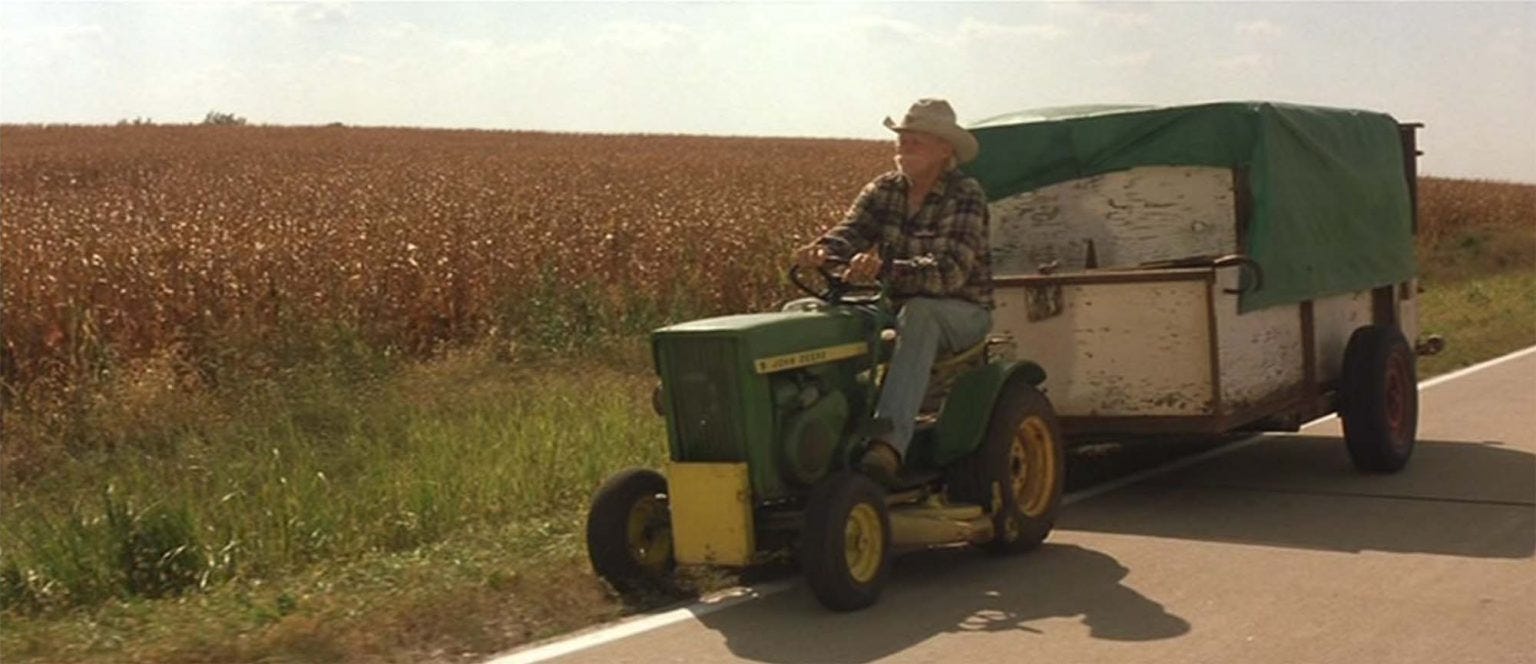
In 1999, David Lynch made the quietest film of his career. No severed ears. No red curtains. No backward-talking dwarfs. The Straight Story is rated G. It’s about an old man on a lawn mower.
Alvin Straight was 73 years old and living in Laurens, Iowa, when he learned his estranged brother Lyle had suffered a stroke 240 miles away in Mount Zion, Wisconsin. Alvin’s eyes were too bad to drive a car. His hips were too bad to walk. So he hitched a trailer to a 1966 John Deere riding mower, pointed it east on Highway 18, and drove.
Five miles an hour. Six weeks. Lynch shot the film along the actual route in autumn of 1998, every scene in chronological order, so the leaves change as you watch. Richard Farnsworth played Alvin at 79. Metastatic prostate cancer was killing him during filming. The paralysis in his legs on screen was real. He earned an Academy Award nomination for Best Actor and held the record as oldest nominee for twenty-one years.
The film has almost no plot. Alvin meets people along the road. A pregnant runaway. A group of cyclists. A fellow World War II veteran outside a bar. They talk. He keeps moving. The John Deere breaks down. He gets it fixed. He keeps moving. The genius of Lynch’s film isn’t what happens. It’s the refusal to make anything happen. The Iowa landscape scrolls by at five miles an hour, and you watch the sky do things you never noticed at sixty-five.
Roger Ebert called it the most human film of the year. He was right for the wrong reason. It’s not human because it’s sentimental. It’s human because it’s slow. Because Alvin doesn’t know what he’ll say to his brother when he gets there, and he goes anyway.
I’ve started doing something on Sunday afternoons that I can’t fully explain. After church. After lunch. After the walls start to feel like they’re listening. I get in the car and drive. No destination. I pick a direction and go.
It started as restlessness. The kind that lives in your legs, not your head. The kind that says the room is fine but the room isn’t enough. I’ve had it since I was a kid in Lima, when the city pressed in and I’d walk to the Malecón just to stand where the land stopped and the Pacific started. I didn’t know what I was looking for then either. I just knew I needed the horizon to be farther away than the nearest wall.
It’s become something else. I’m not sure I have the right word for it yet.
Dallas sits in the Blackland Prairie, which means I’m surrounded by the richest soil in the state, dark and heavy, the kind of dirt that stains your boots and grows cotton without apology. But the prairie is a doorway. An hour in any direction, and you’re in a different country.
Head east and the first thing you cross is water. Lake Ray Hubbard stretches out on both sides of the highway past Rockwall, and for a couple of miles you’re driving over it, the Blackland Prairie behind you and the sky doubled in the surface below. Past the lake the suburbs thin out fast. By Royse City it’s farmland and scattered post oaks, gently rolling, the soil still dark but the land loosening up. The air gets heavier as you go. I roll down the window past Greenville and feel it on my forearms, warm and thick, the humidity of East Texas reaching back toward you before you get there. You’re still in prairie. But you can feel the Piney Woods pulling.
Head west through Fort Worth and out the other side and it’s the opposite sermon. You drive through the Cross Timbers on the way, post oak and blackjack oak on both sides of the highway, and then past Weatherford they start to thin. The green drains out of the land mile by mile. Scattered trees give way to bare pasture, then to ranch country, barbed wire and mesquite and a horizon that keeps backing away from you. I went to university in Abilene, another hundred miles past where I turn around, and I know what that land becomes. But even here, an hour out, the sky doesn’t frame the land. The land frames the sky. You either learn to see what’s actually there or you go a little crazy from what isn’t.
Head north on 75 and I climb through the Blackland into the Red River Valley. The dirt turns from black to rust somewhere around Sherman. Oklahoma’s red clay starts bleeding through before you cross the border. Tornado country. Flat and open and full of weather. I’ve pulled over near Denison and watched the clouds pile into towers three counties wide, rain falling on someone else’s town while the sun sat on mine.
Head south on 67 and the Blackland gives way to something different. Past Midlothian the land starts to roll. By Cleburne you’re in the Cross Timbers, post oak and blackjack oak on sandy soil, the terrain lifting and falling in a way that Dallas never does. The road narrows. The towns get smaller. If you keep going past Cleburne toward Glen Rose the land opens into limestone bluffs along the Paluxy River, and you’re standing in country that’s been there since the Cretaceous. I don’t usually get that far. But even an hour out, the land has shifted under you, and the Blackland Prairie feels like something you dreamed.
Four directions. Four different countries. Four different sermons, if you’re listening.
I don’t plan which way I’ll go. That’s the part that matters. I get on a highway and drive until the land tells me something, and then I drive some more. Sometimes I pull over at a gas station in a town I’ve never heard of and buy a bottle of water. Sometimes I don’t stop at all. There’s a particular loneliness to standing in a parking lot in Greenville or Cleburne where nobody knows your name and the sky is doing something absurd with the light, and you realize you drove forty-five minutes for this and it’s exactly what you needed. Not company. Not answers. Space. The kind of space that lets your chest expand to its actual size.
The point isn’t the stopping. The point is the going without needing to arrive.
Jesus told his disciples, “Come away by yourselves to a desolate place and rest a while” (Mark 6:31). They’d been so busy they hadn’t eaten. Not productivity advice. Not a system. A direction and a verb. Come. Away.
Kathleen Norris is a poet who moved from New York City to Lemmon, South Dakota, population 1,600, to live in the house her grandparents built in 1923. She stayed. In 1993 she wrote Dakota: A Spiritual Geography, a book about what happens when you stop running from emptiness and let it teach you.
She writes: “I have learned to trust the processes that take time, to value change that is not sudden or ill-considered but grows out of the ground of experience. Such change is properly defined as conversion, a word that at its root connotes not a change of essence but of perspective, as turning round; turning back to or returning; turning one’s attention to.”
Conversion as turning. Not transformation. Not becoming someone new. Turning your attention to what was already there.
That’s what the Sunday drive is. Not escape. Not therapy. Conversion in the oldest sense. I drove east last week and the humidity settled on my skin like a language I used to speak. Something in my chest opened that I didn’t know was closed. I drove west two Sundays before that and felt my shoulders drop somewhere past Weatherford, the way they always did on the drive to Abilene, when the sky opened and nothing remained to perform for. I’ve spent most of my life performing for rooms. The ranch country past Weatherford doesn’t ask you to perform. It just asks you to be small, and for once that feels like relief instead of diminishment.
The psalmist wrote, “The heavens declare the glory of God, and the sky above proclaims his handiwork. Day to day pours out speech, and night to night reveals knowledge” (Psalm 19:1-2). I used to read that as poetry. Now I read it as reporting. The farmland past Rockwall says something specific every Sunday I drive through it. So do the post oaks past Cleburne. I just wasn’t in the car.
God told Abraham to go. Didn’t say where. Didn’t give coordinates or a timeline. Just said go, and I’ll show you when you get there. And Abraham went, not knowing where he was going.
I don’t compare a Sunday drive to Abraham’s exodus. That would be ridiculous. But the muscle is the same. The willingness to point yourself in a direction without knowing what you’ll find, and to trust that the finding is the point.
Last Sunday I drove south on 67. Pulled off past Cleburne and sat on the hood of my car in the parking lot of a gas station at the edge of a pasture. Post oaks in every direction, the land rolling away from the road, sandy soil instead of the black clay I’d left behind in Dallas. A truck passed on the highway and then it was quiet in a way that Dallas never is, quiet the way Lima was quiet at 5 a.m. before the micros started grinding through Miraflores.
I didn’t pray exactly. I just sat there and let the land be what it was. Let myself miss things I couldn’t name. Let the ache sit without trying to fix it or explain it or turn it into a lesson.
That was enough. Not the conclusion. The whole sermon.