
Higher Resolution
What's on today's outrage menu?

“We remember the fish we ate in Egypt at no cost. The cucumbers, melons, leeks, onions and garlic. But now we have lost our appetite. We never see anything but this manna.”
Numbers 11:5-6
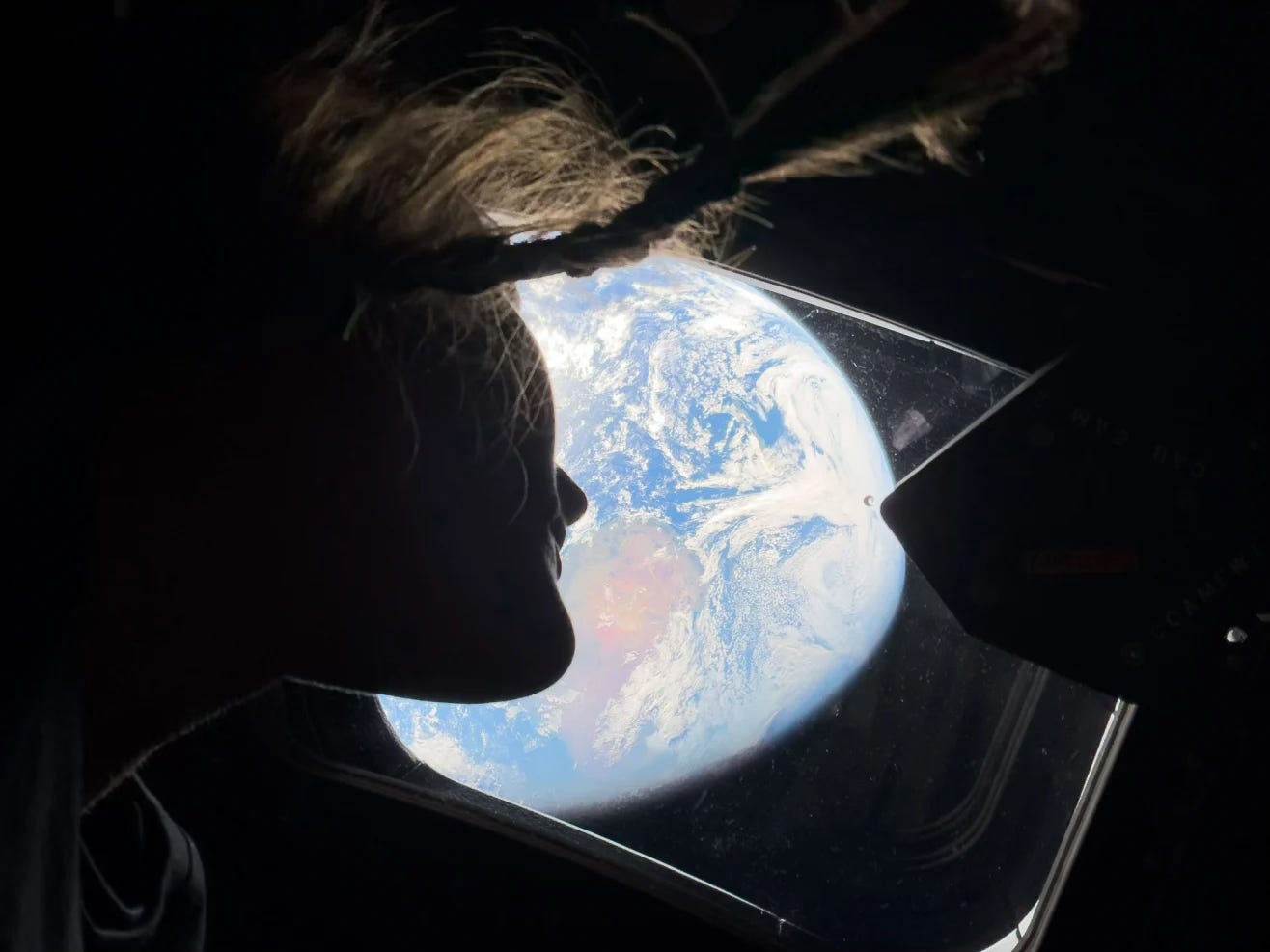
Yesterday, four human beings circled the moon. Reid Wiseman, Victor Glover, Christina Koch, Jeremy Hansen. They traveled 252,756 miles from Earth, farther than any human has ever been, and they photographed the far side of the lunar surface while the rest of us checked our phones. They watched Earth drop below the horizon. Earthset. Then they came around the other side and watched it rise again. The same image William Anders caught from the window of Apollo 8 on Christmas Eve, 1968, with a Hasselblad and one shot. More than half a century since Apollo 17. And we’re back.
The images are breathtaking. Craters within craters. Ancient lava flows darkening the near side. Ridges and cracks in terrain that predates everything alive on this planet. This is what we built. This is what the species can do when it aims upward.
And we’re arguing about the pattern on Elon Musk’s shirt. I peek into Facebook feeds of those I love, like and appreciate. The outrage and hyperbole is disconnected from reality, and close to a form of mental illness that can’t be ignored. I want to both chide and hug them.
I want to sit with all of what I see for a second. Not Elon’s shirt. Not the seriously misinformed posts.
But the distance between what we have and what we notice.
I grew up in the Dewey Decimal System. You wanted to know something, you drove to the library, pulled out the wooden drawers, flipped through cards until your fingers were gray. If your branch didn’t have it, you filled out an interlibrary loan form and waited three weeks. Knowledge was a physical thing. It had geography and weight. You had to go to it.
That world ended. A student in Ouagadougou can take Yale’s Introduction to Molecular Biology right now. On a phone that costs less than a pair of running shoes. The entire corpus of human knowledge, every journal, every lecture, every symphony, every surgical technique, every proof, every poem, sits in the pocket of anyone with a signal. We don’t need a library card. We don’t need proximity to institutions that didn’t want us there. We need Wi-Fi.
Child mortality dropped 59% since 1990. Extreme poverty fell by more than half. Global literacy stands at 87%, the highest in recorded history. More girls attend school right now than at any point in the existence of schools. You can march in the street, curse out the officer protecting the route, post the video, get a million views, and be home for dinner. Try that in 1956. Try that in 1936.
This is the most gilded age in the history of the species. Not for some of us. For all of us. Women. Men. Children. The data isn’t ambiguous. It’s math.
And we’re miserable.
Today the emergency is Iran. The collapse of Western Civilization. The caricatured evil of Trump. Last month the emergency was ICE. Before that, we organized a national economic blackout. Don’t buy anything for twenty-four hours. That’ll show them. Before that, American Eagle ran a jeans ad and the internet called it eugenics because Sydney Sweeney is blonde. Before that, Prada released a sandal and half the internet called it cultural theft from Indian artisans. A shoe. Cultural theft. Before that, Free Palestine. The plight of Gazans. Where are the marches? Are all Gazans ok now, I surmise? Before that, we boycotted Target for thirty-eight consecutive weeks over a diversity program. Before that, the tariffs were going to collapse the global economy by summer. Summer came. The economy held. The sandal sold out. Target is still open. Nobody circled back.
Do you see the pattern? Every month a new catastrophe arrives at the same volume. Every cycle carries the same certainty that this is the one that proves it’s all coming apart. And then it passes. The timeline refreshes. The algorithm delivers the next emergency. And we comply. We perform the outrage. We share the thread. We add our commentary to the pile. And nothing changes except our blood pressure and our capacity for wonder.
Abraham Joshua Heschel was a rabbi who marched with King at Selma and lost his mother and sisters to the Nazis. He had every reason to see the world as a theater of cruelty. But what he diagnosed in 1955 wasn’t a deficit of knowledge. It was a deficit of wonder. “Mankind will not perish for want of information,” he wrote in God in Search of Man, “but only for want of appreciation.” He called the alternative radical amazement. The discipline of seeing what is actually in front of you before the feed tells you what to feel about it.
The Israelites had the condition, not the discipline. They stood in the desert with bread falling from the sky. Bread. From the sky. And they complained about the menu. They missed the cucumbers from Egypt. The garlic. The leeks. Never mind that Egypt meant slavery. Never mind that the bread was a daily, inexplicable miracle. They’d grown accustomed to it. And once you’ve normalized a miracle, the only thing left is the complaint.
That’s us. We’ve normalized the moon. We’ve normalized the supercomputer in our pocket. We’ve normalized the fact that a kid in Burkina Faso can study microbiology at one of the finest universities on earth without leaving his house. We’ve normalized free speech and clean water and the eradication of polio and the ability to yell at a cop and post any form of inanity, researched or purely propagandized, to a global audience of billions. And now we need something to be wrong. Because without the outrage, we’d have to sit still and reckon with how astonishing this actually is. And that’s harder than being angry. Awe requires surrender. Outrage just requires a signal.
The images from Artemis are still coming in. Four people circled the moon yesterday and broke the record for the farthest any human has traveled from home. They saw the Earth rise.
I looked at the photos this morning. I didn’t share them. I didn’t add commentary. I just looked.
What a beautiful world.