
Quick Cash
When giving is taking

A woman from Samaria came to draw water. Jesus said to her, ‘Give me a drink.
John 4:7
Stéphane Audran plays a French chef who once ran the kitchen at the Café Anglais in Paris. She lives in exile now, cooking boiled cod and ale-bread for two elderly sisters and their dwindling Lutheran congregation on the Jutland coast of Denmark. When she wins 10,000 francs in a lottery, she spends every centime on a single meal for twelve villagers who’ve agreed beforehand not to comment on the food. Not to take pleasure. Their piety won’t permit it.
Grace arrives anyway.
When Martine discovers Babette has nothing left, she weeps. Babette’s answer: “An artist is never poor.” She’d emptied the account and kept the thing the account couldn’t hold.
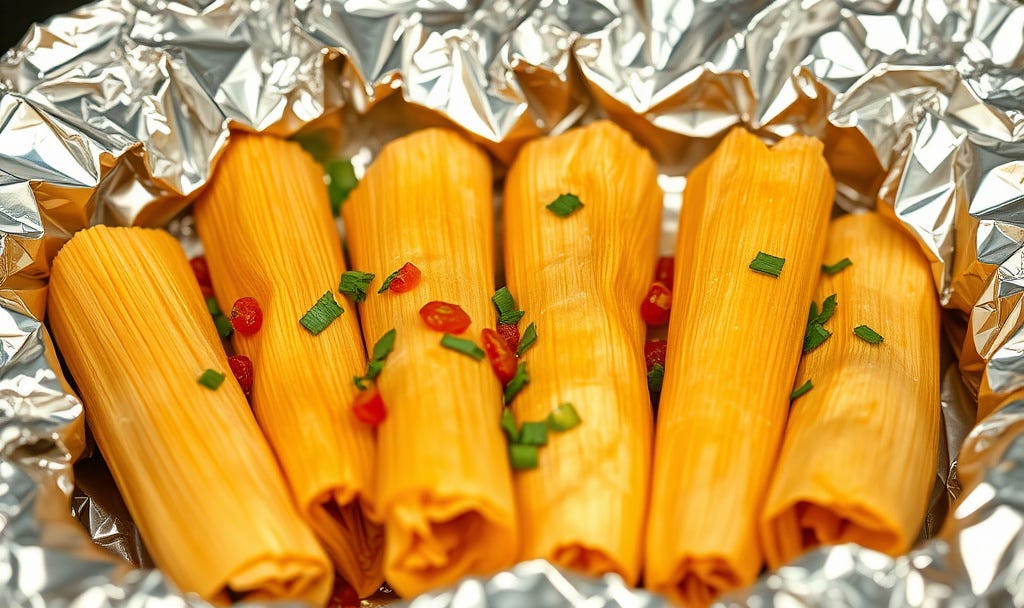
I walked into my lobby after work. She was there. The older woman who walks all over downtown with batches of hot tamales. I don’t know her name. She doesn’t speak English. I no longer eat any form of bread or grain.
She didn’t ask if I wanted tamales. She asked me how I was doing.
I had no cash. I asked her to wait. She smiled and said she’d wait. I crossed the street to the ATM. The screen offered options. I selected the amount for quick cash. Sensible. Walked back. Handed her the bills. Asked for one batch. She flipped through them, smiled, said something about her rent, and hugged me.
She’s 84. She most likely wakes before dawn. Buys the ingredients. Makes the tamales by hand. Makes a green hot sauce that is purely legendary. Keeps everything heated. Walks miles downtown. Tries to earn a living.
I carried the batch upstairs, put it in the freezer for guests
And wept.
Before you call me righteous, hear the rest. The quick cash didn’t even register in my account. A pittance. I tell this story because I walked away richer than I walked in. She gave me the unguarded affection of a hard-working 84-year-old woman who should be sitting in a rocking chair in a finca somewhere, surrounded by great-grandchildren who adore her. She counted my bills, mentioned her rent, and hugged me like I was family.
I am the one who received.
Gustavo Gutiérrez was born in Lima in 1928. The same Lima where I grew up decades later, riding a school bus through San Isidro while he was already a priest in the pueblos jovenez I knew well. In 1971 he wrote, “The neighbor is not the one whom I find in my path, but rather the one in whose path I place myself, the one whom I approach and actively seek.”
I crossed the street to find an ATM. That felt ordinary. But she’d already placed herself in my path. She’d been walking downtown for years, carrying tamales and green sauce and something I didn’t earn and can’t repay.
Jesus sits at a well in Samaria. He’s tired. Thirsty. A woman arrives, and he asks the simplest thing in the world: “Give me a drink.” The God who spoke oceans into existence asks a social outcast for water. In that asking, he opens a conversation that gives her everything. She came to draw water. She left carrying living water.
The tamale lady asked how I was doing. She asked for nothing except my presence. And in return she gave me what Paul calls “a fragrant offering, an acceptable sacrifice, pleasing to God” (Philippians 4:18). The tamales were the offering. The hug was the altar.
Christ keeps arriving this way. In the one who should be receiving but gives instead. In the widow who drops two coins and outgives the treasury (Mark 12:43). In the carpenter’s son who asks for a drink and pours out living water. In an 84-year-old woman with hot sauce and no English who hugs a stranger in a lobby and leaves him undone.
You’ve felt this. The moment you offered what you thought was generosity and discovered you were the one being fed. The exchange that cost you nothing measurable and rearranged something behind your ribs. Someone who had every reason to ask for more and instead gave you all they had.
That’s where Christ lives. Not in the transaction. In the moment the transaction cracks open and becomes communion.
She walked downtown carrying tamales.
I walked upstairs and wept.
I’ve already forgotten the amount.
The warm hug, I haven’t.