
Small Eyes
What the Bee Already Knows

And why are you anxious about clothing? Consider the lilies of the field, how they grow: they neither toil nor spin, yet I tell you, even Solomon in all his glory was not arrayed like one of these.
Matthew 6:28-29
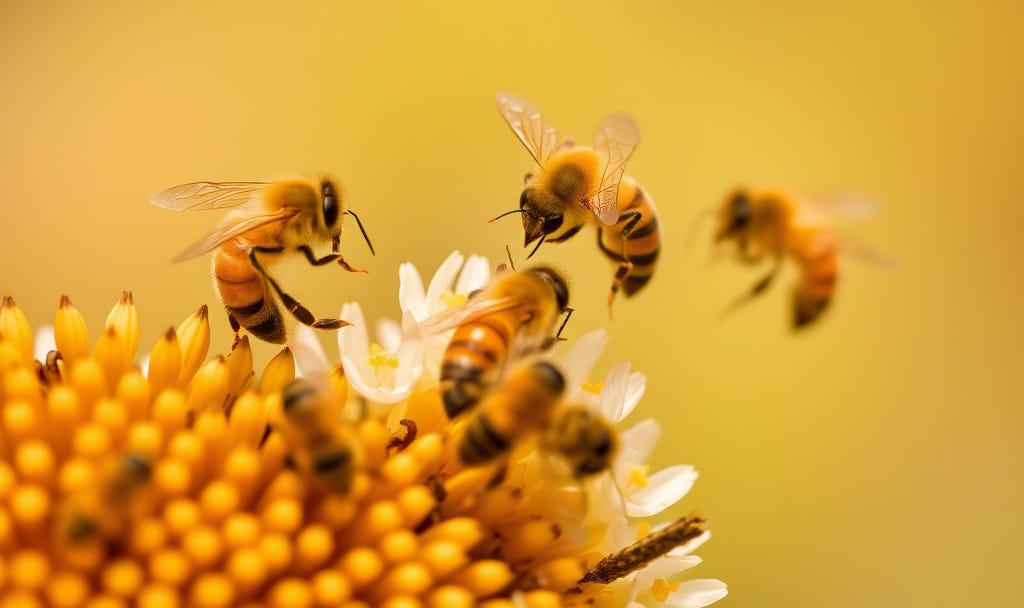
A honeybee has roughly seven thousand lenses in each eye. That sounds like a lot until you learn what it means. Each lens captures a tiny fragment of light, and the brain pieces those fragments into something closer to a mosaic than a photograph. Where you and I see petals and color gradients and the fine veins running through a leaf, a bee sees a blurred field of shapes. If a bee tried to read this sentence, it couldn’t make out the first letter.
But bees don’t need to read. They need to find flowers.
In 2004, researchers at Queen Mary, University of London, raised bumblebees in a controlled lab. No gardens. No meadows. No flowers of any kind. Bees that had never seen a petal in their lives. They put two patterns in front of them, one symmetric, one not. The bees chose symmetry every time. No training. No reward history. They knew what they were looking for before they’d ever seen it.
The preference is built in. Hardwired into the nervous system like a tuning fork set to one frequency. And the world outside the lab was made to match. The petals of most flowering plants are bilaterally symmetric. Their color patterns concentrate toward the center in what botanists call nectar guides, pathways painted in ultraviolet light that human eyes can’t detect but bee eyes read like a lit runway. The flower doesn’t broadcast on every frequency. It broadcasts on the one the bee was made to receive.
The signal and the receiver. Made for each other.
Jakob von Uexküll was an Estonian-German biologist who coined the word Umwelt in 1934. He spent his career studying how creatures perceive the world, and his insight was simple and radical: no two species inhabit the same reality. A tick’s entire universe consists of three things. The smell of butyric acid. The warmth of blood. The texture of skin. Nothing else gets in. Uexküll wrote that we must “blow, in fancy, a soap bubble around each creature to represent its own world, filled with the perceptions which it alone knows.”
A soap bubble.
I’ve spent thirty years designing digital interfaces. That’s Umwelt work, whether I had the word for it or not. Every user who opens a dashboard brings a different set of eyes. A network engineer in Atlanta sees one screen. A product manager in San Jose sees another. The pixels don’t change. The perception does. My whole career has been arranging information so that different eyes find what they need without demanding that everyone see the same thing.
We all live inside our bubbles. Every one of us. I grew up in Peru and moved to West Texas for university. Two countries, two sets of rules for how the world works, two ways of reading a room. I could see the edges of each because I’d lived inside the other one. That’s what happens when you grow up between worlds. You see every bubble from the outside. You never fully settle into one.
But that’s not a defect. That’s the design.
The bee wasn’t built to see everything. It was built to see what matters. And the world was made to meet it there. The flower doesn’t demand better eyes. It arranges its petals in the pattern the bee was already made to recognize.
Consider the lilies, Jesus said. He’s on a hillside talking to fishermen and tax collectors and women who’ve been hauling water since before sunrise. Their Umwelt is survival. Next week’s bread. The sandal that needs mending. They can’t see the kingdom because the kingdom isn’t shaped like anything they know how to look for.
He doesn’t say see better. He says look at the flower.
The lily doesn’t toil. Doesn’t spin. Doesn’t perform. And yet the Creator clothed it more beautifully than Solomon ever managed with all his gold. The flower was made to be found. Not by perfect eyes. By whatever eyes are looking.
Paul knew this. He told the Corinthians that we see through a glass, darkly. Partial perception. Inherited maps. Categories we didn’t build and can’t fully see past. But he also told the Romans that God’s invisible qualities have been clearly seen, understood from what has been made. The design speaks. Even through seven thousand lenses that can’t tell a letter from a blur, the pattern is legible.
And then John. The Word became flesh and dwelt among us. God didn’t wait for us to develop better vision. He entered the bubble. Showed up as a man who ate fish on a beach. Who wept at a friend’s tomb. Who broke bread with people who couldn’t hold a consistent thought about who he was.
The flower doesn’t ask the bee to become human first.
You don’t have to see the whole picture. You weren’t made to. None of us were. We live inside our soap bubbles, every one of us, and the glass is dark, and the lenses are few, and the maps we carry were drawn by someone else.
The flower was made to find you, too.
Wonderful, Micah. Absolutely wonderful !